
Equality, Diversity and Inclusion

Promoting protected characteristics at LPPA
At LPPA we work to ensure that our children know and understand that:
- Everyone is welcome at LPPA
- Everyone is different
- We celebrate our differences
- We are all equal in our differences
The Equality Act became law in 2010. It covers everyone in Britain and protects people from discrimination, harassment and victimisation. Everyone in Britain is protected. This is because the Equality Act protects people against discrimination because of the protected characteristics that we all have. Under the Equality Act, there are nine Protected Characteristics:
- Age
- Disability
- Present yourself (Gender Reassignment)
- Race
- Religion or belief
- Marriage or civil partnership
- Sex
- who we choose to love (Sexual orientation)
- Pregnancy and maternity
Under the Equality Act you are protected from discrimination:
- When you are in the workplace
- When you use public services like healthcare or education
- When you use businesses and other organisations that provide services and goods (like shops, restaurants, and cinemas)
- When you use transport
- When you join a club or association.
- When you have contact with public bodies like your local council or government departments
The 9 Protected Characteristics are actively promoted in our school through:
- Our school ethos statements, SDP, and SEF
- Our school core 'Flying High' values and expectations
- Our schools Equalities Policy
- Conscious role modelling by all adults in the school community
- Active engagement and communication with parents and carers
- Assemblies
- The promotion of British Values throughout school
- Promoting articulation by building appropriate language and a coherent vocabulary
- Developing a love of reading through a range of authors and genres
- Personal, Social, Health and Economic education (PSHE) sessions
- Religious Education (RE) lessons
- Sporting, Art and Cultural Events
- Pupil Voice
- Educational visits
- Real-life learning outside the classroom
- Guest speakers
- Developing links with local, national and international communities
- Extra-curricular activities, after-school clubs, charity fundraising and work within the local community
Embedding Protected Characteristics into the whole ethos of LPPA promotes:
- Self-esteem, self-knowledge and self-confidence
- Respect for democracy and support for participation in the democratic process
- Acceptance of responsibility for their own behaviour
- Respect for their own and other cultures
- Understanding of how they can contribute positively to school and home life and to the lives of those living and working in the locality and further afield
- An understanding of Equality, Human Rights and Protected Characteristics
- An understanding of how citizens can influence decision-making through the democratic process
- An appreciation that living under the rule of law protects individual citizens and is essential for their wellbeing and safety
- An understanding that the freedom to choose and hold other faiths and beliefs is protected in law
- An acceptance that other people having different faiths or beliefs to oneself (or having none) should be accepted and tolerated, and should not be the cause of prejudicial or discriminatory behaviour
- An understanding of the importance of identifying and combating discrimination
How do we use our PSHE curriculum to support children’s understanding and the teaching of Protected Characteristics?
The protected characteristics are taught in a way that is progressive and developmental for all ages in a pupil-centred way. Our inclusive approach starts with children in Nursery and Reception and continues to develop through each key stage up to year 6.
Children recognise each of the protected characteristics through the use of key symbols which are used across the curriculum throughout school. For each symbol there is a definition that helps to support children’s understanding and articulation of each of the nine protected characteristics. Our curriculum is carefully tailored to meet the developmental needs of all age groups within our school, ensuring that learning is both accessible and meaningful for every child. Each class revisits and explores in detail a new protected characteristic, building on prior knowledge and deepening understanding over time. In Reception we lightly touch on some of the Protected Characteristics in relationship of the needs of our pupils at an age and stage of aproppriateness. See diagram below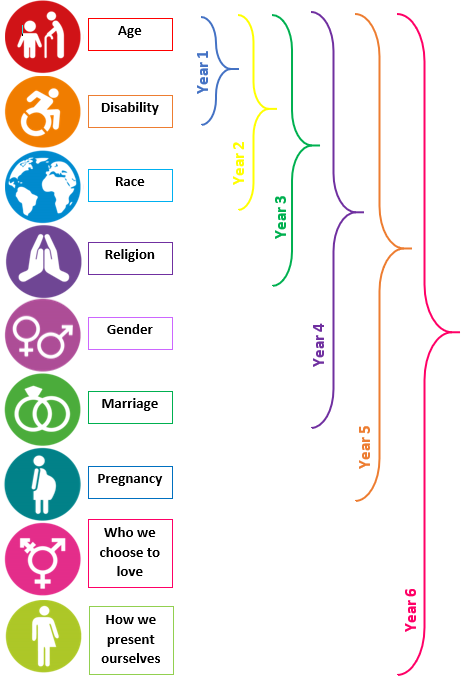
Sessions are taught in a safe, open and inclusive learning environment based on trusting relationships between all members of the class, adults and students alike. Children are encouraged to discuss the ideas and learning in their lessons at home, but to show their classmates the respect and privacy that they would want in return.
Significant Individuals:
Age: old/young- Greta Thunberg-climate control, Queen Elizabeth-yougest to be crowned and reined the longest, Martin Luther King-youngest Nobel Peace Prize winner
Disabilities: Dyslexia-Jamie Oliver/Marcus Rashford, Greta Thunburg-Asperger syndrome
Race: Simone Biles-she made headlines at the 2020 Olympics for prioritizing her mental health, Marcus Rashford-children food charity,
Gender: equalities- Suffragettes, Amelia Earhart- pilot
Religion: All year groups- new units- world views approach, Dali Lama, Mother Teresa
Marriage: Beckhams-marriage conflict, Tom Daley- same-sex civil partnership,
Pregnancy: Parents, signs e.g give up your seat
Who we choose to love: Elton John. Tom Daley, Ellen DeGeneres, Bella Ramsey
Present yourself: Bella Ramsey- non binary, Elton John, RuPaul